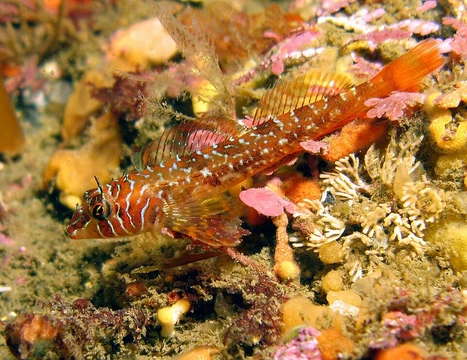
Slimehead
Deep-sea fish with mucus-filled heads and disputed longevity.

Slimeheads, also known as roughies and redfish, are mostly small, exceptionally long-lived, deep-sea beryciform fish constituting the family Trachichthyidae. Found in temperate to tropical waters of the Atlantic, Indian, and Pacific Oceans, the family comprises about 50 species in eight genera. They are named for the network of muciferous canals riddling their heads. The larger species—namely the orange roughy (Hoplostethus atlanticus) and Darwin's slimehead (Gephyroberyx darwinii)—are the target of extensive commercial fisheries off Australia and New Zealand, but many populations have already crashed due to overfishing, raising questions about the future viability of these fisheries.
- field
- Ichthyology
- known_for
- Exceptionally long-lived deep-sea fish; target of commercial fisheries; named for mucus-filled head canals
- max_size
- 75 cm standard length, 7 kg
- family
- Trachichthyidae
- species_count
- About 50 in eight genera
Lore & Background
Slimeheads have a typically deep-bodied, laterally compressed form, with large heads, large eyes, and in some species bright colors. The head is notable for its network of mucus-filled canals, part of the lateral line system. They range from bright brick red to dusky grey or silver to black; reds quickly fade to orange after death. Some species are reported to be bioluminescent, probably due to symbiotic bacteria. The largest species is the orange roughy, reaching 75 cm standard length and 7 kg, but most slimeheads are well under 30 cm. They feed primarily on zooplankton such as mysid shrimp, amphipods, euphausiids, prawns, and larval fish. They store energy as extracellular wax esters, which help maintain neutral buoyancy. Some species form dense aggregations, possibly segregated by sex, around undersea canyons and seamounts. The orange roughy loses almost all pigmentation while inactive and is very approachable during that time. Slimeheads are pelagic spawners, releasing eggs and sperm directly into the water. The fertilized eggs and larvae are planktonic. Predators include large deep-roving sharks, cutthroat eels, merluccid hakes, and snake mackerels.
Reader's Guide
Slimeheads are significant primarily for their role in commercial fisheries and as examples of extreme longevity in fish. The orange roughy and Darwin's slimehead have been heavily fished off Australia and New Zealand, leading to population crashes and concerns about overfishing. Their slow reproduction rate threatens the sustainability of these fisheries. The family's distinctive mucus-filled head canals and bioluminescence in some species also contribute to their biological interest. Their aggregating behavior, metabolic phases, and reliance on specific geologic structures like seamounts highlight their ecological specialization and vulnerability to habitat disturbance. The entry underscores the need for careful management of deep-sea fisheries and the challenges of conserving slow-growing, long-lived species.
Did You Know?
- Slimeheads are named for the network of muciferous canals riddling their heads.
- Some slimehead species, such as Aulotrachichthys latus, are reported to be bioluminescent, probably by symbiotic bacteria.
- Orange roughy aggregations may reach a population density of 2.5 fish per square meter.
Frequently Asked Questions
What is a Slimehead?
Slimeheads are a group of small, deep-sea beryciform fish belonging to the family Trachichthyidae, with roughly 50 species spread across eight genera. They inhabit temperate and tropical waters in the Atlantic, Indian, and Pacific Oceans, and get their common name from a dense network of mucus-producing canals running through their heads.
How does Slimehead's story end?
Many slimehead populations, especially the orange roughy and Darwin's slimehead off Australia and New Zealand, have already been heavily depleted by intensive commercial trawling. Their slow growth and late maturity make recovery from overfishing particularly slow and uncertain.
Why is Slimehead important to science and industry?
They are a major target of deep-sea commercial fisheries, making them economically significant for coastal nations. Biologically, their disputed lifespan and deep-sea ecology make them a key subject of study in ichthyology and marine conservation.
What exactly is a 'muciferous canal' in a Slimehead's head?
It is a channel running through the skull that secretes mucus, and these canals form a distinctive network across the head region. This feature is the defining characteristic that gives the group its common name and helps distinguish them from other beryciform fish.
More in Aquatic Invertebrates 25-34
Elsewhere in the Aquatic Invertebrates universe
Spotted an error? Know more?
This is a living reference — every entry is fact-audited, and reader corrections feed straight into our audit queue. Suggest an edit · See this site's audit record