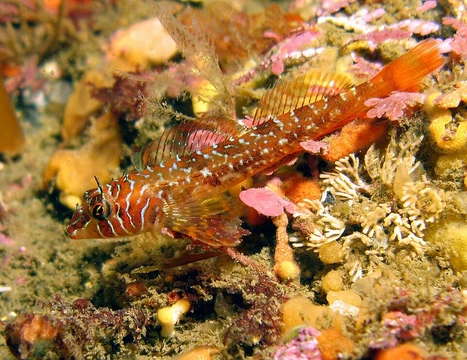
Slimehead
Deep-sea fish with mucus-filled heads and disputed longevity.
Slimeheads—also called roughies or redfish—are mostly small, deep-sea fish that live a very long time. They belong to the family Trachichthyidae (from Greek words meaning "rough fish") and are found in temperate and tropical waters across the Atlantic, Indian, and Pacific Oceans. The family includes about 50 species in eight genera. Their name comes from the network of mucus-filled canals that riddle their heads. The larger species, especially the orange roughy and Darwin's slimehead, are heavily fished commercially off Australia and New Zealand. Many of their populations have already collapsed, and others show severe overfishing. Because slimeheads reproduce so slowly, the future of these fisheries is uncertain. Orange roughies are sold fresh or frozen as food fish, while Darwin's slimeheads are used for oil and fishmeal.
Slimeheads typically have deep, flattened bodies, large heads, big eyes, and (in some species) bright colors. The head is notable for its mucus-filled canals, which are part of the lateral line system. Similar head canals appear in fangtooths and ridgeheads. The head is usually blunt, with a large, slanted mouth; the snout may stick out slightly past the upper jaw. Short, sharp spines sit on the preoperculum, operculum, and post-temporal bone, with the last spine pointing backward. Species in the genera *Optivus*, *Paratrachichthys*, and *Sorosichthys* have more elongated bodies than other slimeheads.
All fins are spinous (except the low pectoral fins) and rounded. The single dorsal fin has three to eight spines and 10–19 soft rays; the pelvic fins are placed on the thorax, with one spine and six or seven soft rays; the anal fin has two or three spines and eight to 12 soft rays; even the forked tail fin has four to seven procurrent spines on each lobe. Their scales are ctenoid but vary between species—some fall off easily, others stay attached. In most species, the scales on the belly between the pelvic fin and anus form a ridge of large, bony scutes. The lateral line is clear and unbroken, though its pores are mostly hidden by the scales' spiny projections.
Slimeheads range in color from bright brick red (with fins the same shade) to dusky gray or silver, to black with dusky gray or clear fins. The red fades quickly to orange after death. Some species, like *Aulotrachichthys latus*, are thought to be bioluminescent, likely from symbiotic bacteria, as seen in other beryciform fish. The largest species is the orange roughy, reaching a maximum standard length of 75 cm and weight of 7 kg; most slimeheads are well under 30 cm.
Most slimeheads are sluggish and live near the bottom of continental slopes, at cold, moderate depths of about 100 to 1,500 meters, usually over hard, rocky ground. The more elongated species tend to be more active and live in shallower water. For example, the slender roughy (*Optivus elongatus*) is found in sunlit coastal waters near rocky reefs; it is nocturnal and hides in crevices during the day. *Trachichthys australis* has a similar shape but is deeper-bodied, resembling a soldierfish. Both young and adult slimeheads eat zooplankton—mysid shrimp, amphipods, euphausiids, prawns, other crustaceans, and larval fish. They store energy as wax esters, which helps them stay neutrally buoyant.
Slimehead behavior is not well studied, but some species form dense groups from time to time. For orange roughy, these groups (possibly separated by sex) can reach a density of 2.5 fish per square meter. They gather around undersea canyons and seamounts, likely where water movement and mixing are high, bringing lots of prey. These groups do not necessarily form for spawning; instead, the fish may cycle through feeding and resting phases, seeking areas with good water conditions for each phase. Observations from submersible dives show that inactive orange roughy lose almost all their pigment and become easy to approach. Their metabolic phases may be tied to seasonal changes in prey, with the inactive phase helping them save energy when food is scarce.
Slimeheads spawn in open water: they form spawning groups and release eggs and sperm into the water. Some species show evidence of seasonal migration. The fertilized eggs and larvae drift with currents until the larvae are strong enough to swim on their own. Only the commercially important species have been studied in detail. Darwin's slimehead larvae and juveniles live in shallow coastal waters, while orange roughy early life stages stay in deeper water (around 200 m). Slimeheads grow very slowly and live a long time; the orange roughy is among the longest-lived animals known, with a maximum reported age of 149 years (though this is disputed). Their predators are not well documented.
- field
- Ichthyology
- known_for
- Exceptionally long-lived deep-sea fish; target of commercial fisheries; named for mucus-filled head canals
- max_size
- 75 cm standard length, 7 kg
- family
- Trachichthyidae
- species_count
- About 50 in eight genera
Lore & Background
Slimeheads have a typically deep-bodied, laterally compressed form, with large heads, large eyes, and in some species bright colors. The head is notable for its network of mucus-filled canals, part of the lateral line system. They range from bright brick red to dusky grey or silver to black; reds quickly fade to orange after death. Some species are reported to be bioluminescent, probably due to symbiotic bacteria. The largest species is the orange roughy, reaching 75 cm standard length and 7 kg, but most slimeheads are well under 30 cm. They feed primarily on zooplankton such as mysid shrimp, amphipods, euphausiids, prawns, and larval fish. They store energy as extracellular wax esters, which help maintain neutral buoyancy. Some species form dense aggregations, possibly segregated by sex, around undersea canyons and seamounts. The orange roughy loses almost all pigmentation while inactive and is very approachable during that time. Slimeheads are pelagic spawners, releasing eggs and sperm directly into the water. The fertilized eggs and larvae are planktonic. Predators include large deep-roving sharks, cutthroat eels, merluccid hakes, and snake mackerels.
Reader's Guide
Slimeheads are significant primarily for their role in commercial fisheries and as examples of extreme longevity in fish. The orange roughy and Darwin's slimehead have been heavily fished off Australia and New Zealand, leading to population crashes and concerns about overfishing. Their slow reproduction rate threatens the sustainability of these fisheries. The family's distinctive mucus-filled head canals and bioluminescence in some species also contribute to their biological interest. Their aggregating behavior, metabolic phases, and reliance on specific geologic structures like seamounts highlight their ecological specialization and vulnerability to habitat disturbance. The entry underscores the need for careful management of deep-sea fisheries and the challenges of conserving slow-growing, long-lived species.
Did You Know?
- Slimeheads are named for the network of muciferous canals riddling their heads.
- Some slimehead species, such as Aulotrachichthys latus, are reported to be bioluminescent, probably by symbiotic bacteria.
- Orange roughy aggregations may reach a population density of 2.5 fish per square meter.
Frequently Asked Questions
What is a Slimehead?
Slimeheads are a group of small, deep-sea beryciform fish belonging to the family Trachichthyidae, with roughly 50 species spread across eight genera. They inhabit temperate and tropical waters in the Atlantic, Indian, and Pacific Oceans, and get their common name from a dense network of mucus-producing canals running through their heads.
How does Slimehead's story end?
Many slimehead populations, especially the orange roughy and Darwin's slimehead off Australia and New Zealand, have already been heavily depleted by intensive commercial trawling. Their slow growth and late maturity make recovery from overfishing particularly slow and uncertain.
Why is Slimehead important to science and industry?
They are a major target of deep-sea commercial fisheries, making them economically significant for coastal nations. Biologically, their disputed lifespan and deep-sea ecology make them a key subject of study in ichthyology and marine conservation.
What exactly is a 'muciferous canal' in a Slimehead's head?
It is a channel running through the skull that secretes mucus, and these canals form a distinctive network across the head region. This feature is the defining characteristic that gives the group its common name and helps distinguish them from other beryciform fish.
More in Aquatic Invertebrates 1-24
Spotted an error? Know more?
This is a living reference — every entry is fact-audited, and reader corrections feed straight into our audit queue. Suggest an edit · See this site's audit record