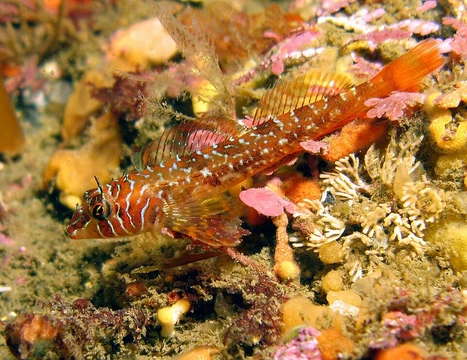
Squat lobster
Dorsoventrally flattened crustaceans with curled tails, found worldwide.

Squat lobsters are dorsoventrally flattened crustaceans with long tails held curled beneath the cephalothorax. They belong to the decapod infraorder Anomura, alongside hermit crabs and mole crabs, and are found worldwide in oceans from near the surface to deep-sea hydrothermal vents, with one species occupying caves above sea level. Some species form dense aggregations on the sea floor or in the water column, and a small number are commercially fished.
- field
- Crustacean biology
- known_for
- Morphological intermediate between lobsters and crabs; dense aggregations; deep-sea and cave habitats
- genera
- Around 60 (61 including Aeglidae)
- size_range
- 18 to 89 mm (0.7 to 3.5 in) in length
Lore & Background
Squat lobsters share most morphological features across their two main groups, Galatheoidea and Chirostyloidea. They resemble true lobsters but are smaller and dorsoventrally flattened, with a cephalothorax longer than broad and a pleon partly flexed under it, making them a morphological intermediate between lobsters and crabs. The cephalothorax is covered by a thick carapace, often with a rostrum, and bears five pairs of pereiopods, the first being chelipeds that can exceed six times body length. The pleon has six somites, with pleopods varying between sexes; females use them to attach eggs, males have gonopods for spermatophore transfer. Development involves five embryonic stages lasting several months, with egg diameter and volume increasing through each stage. Fecundity increases with smaller eggs and larger body size, with more eggs found at lower latitudes and cooler temperatures. Squat lobsters exhibit diverse behaviors, including benthic aggregation around productive deep-sea areas like hydrothermal vents, cold seeps, and shipwrecks, where they use structures for shelter and food accumulation. Some species, like Pleuroncodes planipes and Munida gregaria, perform ontogenetic migrations and form large pelagic swarms, with M.
Reader's Guide
Squat lobsters are significant as a diverse and widespread group within the decapod infraorder Anomura, bridging morphological features between lobsters and crabs through carcinisation. Their global distribution from surface waters to deep-sea hydrothermal vents and caves, as well as high-altitude freshwater habitats (if Aeglidae are included), highlights their ecological adaptability. They play key roles in deep-sea ecosystems, forming dense aggregations that influence nutrient cycling and serve as prey or competitors. The commercial fishing of a few species underscores their economic importance. Their varied reproductive strategies, including ontogenetic niche shifts and pelagic swarming, offer insights into life-history evolution in extreme environments. The ongoing discovery of new species and anatomical studies using micro-computer tomography continue to refine understanding of their phylogeny and adaptation.
Did You Know?
- One species of squat lobster occupies caves above sea level.
- The chelipeds of some squat lobsters can be more than six times the body length.
More in Aquatic Invertebrates 1-24
Elsewhere in the Aquatic Invertebrates universe
Spotted an error? Know more?
This is a living reference — every entry is fact-audited, and reader corrections feed straight into our audit queue. Suggest an edit · See this site's audit record